

Why Hospitality Procurement Still Runs on WhatsApp, PDFs & Spreadsheets
Behind the scenes of venue sourcing, proposal creation, and procurement workflows — and why the industry is overdue for operational infrastructure.
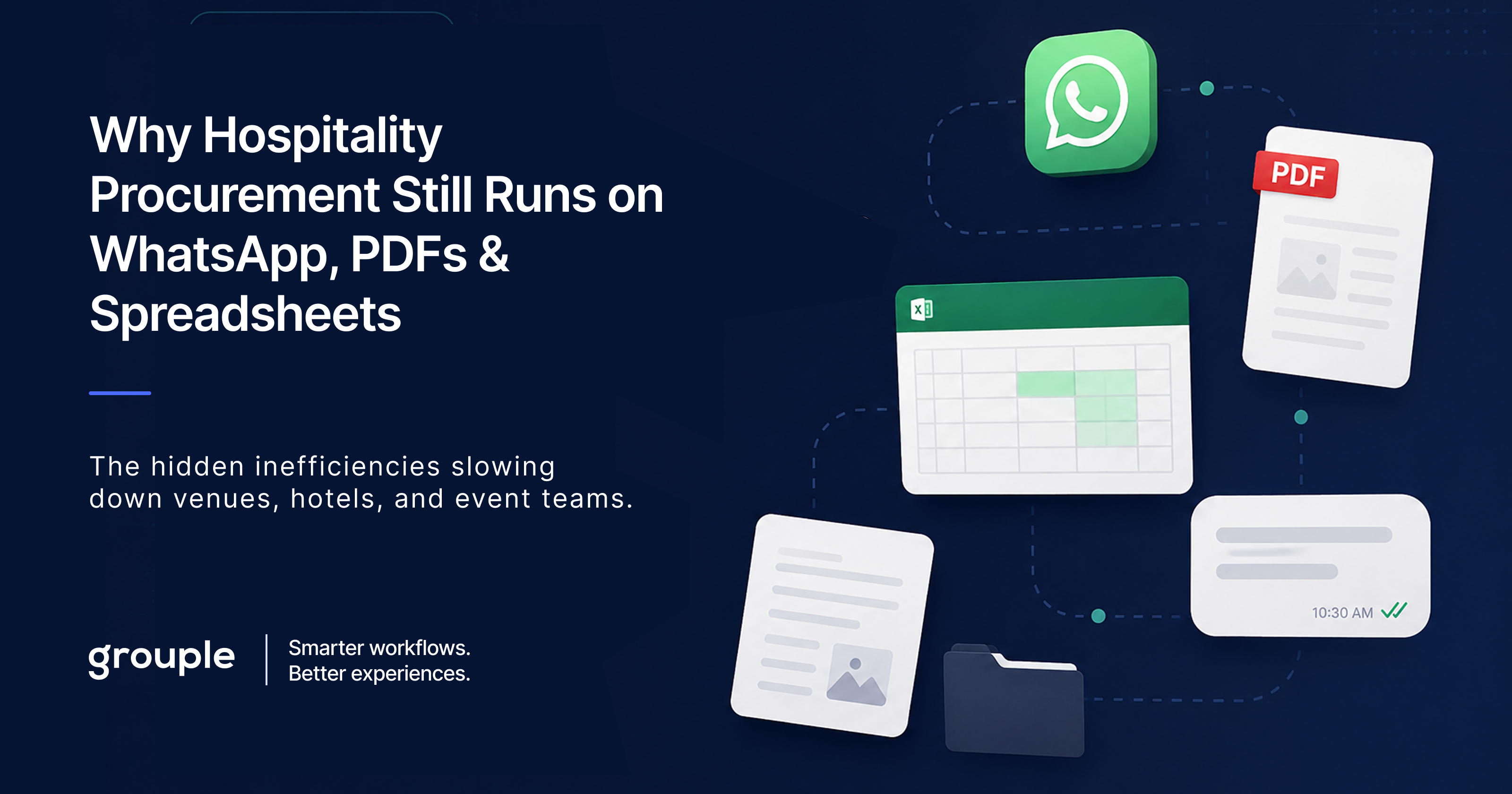
The hospitality and events industry has evolved dramatically over the last decade.
Guest experiences have become more personalized. Venues are investing heavily in technology. AI is rapidly entering operations, marketing, and customer engagement.
But behind the scenes, a surprising amount of business-critical procurement and sales activity still runs on:
WhatsApp groups
PDF brochures
Email threads
Phone calls
Excel spreadsheets
Manually created proposals
For an industry that handles high-value transactions daily, the operational infrastructure powering procurement and venue sales is still incredibly fragmented.
The Reality Behind Hospitality Operations
Whether it’s a hotel sourcing vendors, a venue responding to an event inquiry, or a planner collecting proposals from multiple suppliers, the workflow often looks something like this:
A requirement is shared over WhatsApp or email
Vendors send PDF brochures and pricing sheets
Teams manually compare packages in spreadsheets
Proposal documents are recreated repeatedly
Follow-ups happen across multiple disconnected channels
Final decisions rely heavily on manual coordination
The process is familiar — but far from efficient.
And as businesses scale, the operational complexity grows exponentially.
The Problem Isn’t Just Inefficiency
Manual workflows create several hidden operational problems:
Information Lives Everywhere
Pricing, packages, menus, vendor details, and proposal templates are scattered across inboxes, drives, PDFs, and chats.
Teams often spend more time searching for information than actually closing business.
Proposal Creation Becomes Repetitive Work
Sales and operations teams repeatedly recreate similar proposals using old documents and templates.
Even small updates to pricing or packages require manual edits across multiple files.
Procurement Lacks Visibility
Comparing vendors, tracking negotiations, and standardizing procurement decisions becomes difficult when workflows are spread across spreadsheets and messaging apps.
This slows decision-making and increases the chances of errors.
Scaling Operations Gets Hard
What works for a small team handling a few requests quickly becomes unsustainable for businesses managing high inquiry volumes, multiple venues, or large vendor networks.
Why Hasn’t the Industry Changed Faster?
Hospitality workflows are deeply relationship-driven.
Much of the industry still relies on personal communication, flexibility, and operational improvisation. WhatsApp is convenient. PDFs are easy to share. Spreadsheets feel familiar.
But convenience at a small scale often creates operational bottlenecks at a larger scale.
The industry has also historically lacked modern workflow infrastructure designed specifically for hospitality and event operations.
Most businesses have adapted generic tools rather than purpose-built systems.
Why This Is Starting to Change
Several shifts are now pushing the industry toward modernization:
Increasing operational complexity
Higher inquiry volumes
Faster response expectations
Multi-venue portfolio management
Growing pressure on margins
The rise of AI-powered workflow automation
AI is beginning to unlock new possibilities for hospitality operations:
Extracting structured data from PDFs
Building searchable sales libraries
Automating proposal generation
Standardising procurement workflows
Improving response speed and consistency
Instead of teams manually piecing together information across disconnected systems, workflows can become centralized, searchable, and scalable.
The Future of Hospitality Operations
Hospitality has always been a relationship-first industry — and that won’t change.
But the operational systems supporting those relationships are overdue for modernisation.
The businesses that adopt better workflow infrastructure will likely gain advantages in:
speed
consistency
operational efficiency
procurement visibility
sales conversion
Over the next few years, procurement and sales operations in hospitality may look very different from the fragmented workflows many teams still deal with today.
And for an industry built around experiences, operational experience matters too.